Section9.3Determinants: geometry and invertibility
As invertibility plays a central role in this chapter, we need a criterion that tells us when a matrix is invertible. We already know that a square matrix is invertible if and only if it is row equivalent to the identity matrix. In this section, we will develop a second, numerical criterion that tells us when a square matrix is invertible.
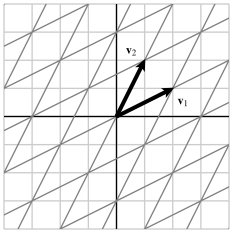
To begin, let’s consider a \(2\times2\) matrix \(A\) whose columns are vectors \(\vvec_1\) and \(\vvec_2\text{.}\) We have frequently drawn the vectors and studied the linear combinations they form using a figure such as Figure 9.3.1.
Figure9.3.1.Linear combinations of two vectors \(\vvec_1\) and \(\vvec_2\) form a collection of congruent parallelograms.
Notice how the linear combinations form a set of congruent parallelograms in the plane. In this section, we will use the area of these parallelograms to define a numerical quantity called the determinant that tells us whether the matrix \(A\) is invertible.
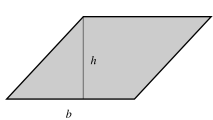
To recall, the area of parallelogram is found by multiplying the length of one side by the perpendicular distance to its parallel side. Using the notation in the figure, the area of the parallelogram is \(bh\text{.}\)
Exploration9.3.1.
We will explore the area formula in this preview activity.
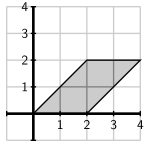
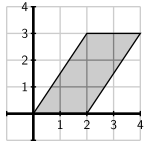
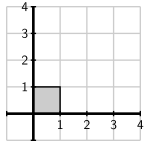
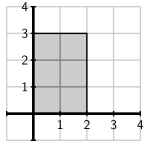
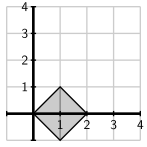
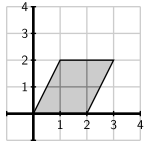
Find the area of the following parallelograms.
1.
2.
3.
4.
5.
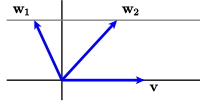
Explain why the area of the parallelogram formed by the vectors \(\vvec\) and \(\wvec_1\) is the same as that formed by \(\vvec\) and \(\wvec_2\text{.}\)
Solution.
We find the following areas.
A \(1\times1\) square has area 1.
A \(2\times3\) rectangle has area 6.
The square has side length \(\sqrt{2}\) giving an area of 2.
If we consider the horizontal length as the base, we see that \(b=h=2\) so that the area is 4.
In the same way, we can consider both the base and height to be 2 so that the area is 4.
If we consider the base to be the length of \(\vvec\text{,}\) then the height, which is the perpendicular distance to its parallel side, is the same in both parallelograms.
Subsection9.3.1Determinants of \(2\times2\) matrices
We will begin by defining the determinant of a \(2\times2\) matrix \(A =
\left[\begin{array}{rr} \vvec_1 \amp \vvec_2
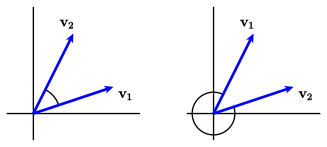
\end{array}\right]\text{.}\) First, however, we need to define the orientation of an ordered pair of vectors. As shown in Figure 9.3.2, an ordered pair of vectors \(\vvec_1\) and \(\vvec_2\) is called positively oriented if the angle, measured in the counterclockwise direction, from \(\vvec_1\) to \(\vvec_2\) is less than \(180^\circ\text{;}\) we say the pair is negatively oriented if it is more than \(180^\circ\text{.}\)
Figure9.3.2.The vectors on the left are positively oriented while the ones on the right are negatively oriented.
Definition9.3.3.
Suppose a \(2\times2\) matrix \(A\) has columns \(\vvec_1\) and \(\vvec_2\text{.}\) If the pair of vectors is positively oriented, then the determinant of \(A\text{,}\) denoted \(\det(A)\text{,}\) is the area of the parallelogram formed by \(\vvec_1\) and \(\vvec_2\text{.}\) If the pair is negatively oriented, then \(\det(A)\) is minus the area of the parallelogram.
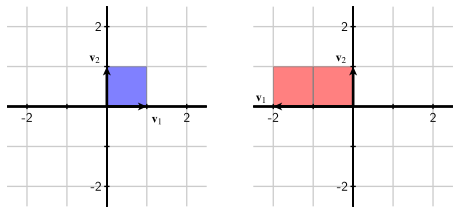
As seen on the left of Figure 9.3.5, the vectors \(\vvec_1 = \evec_1\) and \(\vvec_2=\evec_2\) form a positively oriented pair. Since the parallelogram they form is a \(1\times1\) square, we have \(\det(I) = 1.\)
Figure9.3.5.The determinant \(\det(I) = 1\text{,}\) as seen on the left. On the right, we see that \(\det(A) = -2\) where \(A\) is the matrix whose columns are shown.
As seen on the right of Figure 9.3.5, the vectors \(\vvec_1\) and \(\vvec_2\) form a negatively oriented pair. The parallelogram they define is a \(2\times1\) rectangle so we have \(\det(A) = -2\text{.}\)
Activity9.3.2.
In this activity, we will find the determinant of some simple \(2\times2\) matrices and discover some important properties of determinants.
Instructions.
The sliders in the diagram below allow you to choose a matrix \(A=\begin{bmatrix}a \amp b \\
c \amp d \\
\end{bmatrix}\text{.}\) The two vectors representing the columns of the matrix, along with the parallelograms they define, are shown below.
Figure9.3.6.The geometric meaning of the determinant of a matrix.
Use the diagram to find the determinant of the matrix \(\left[\begin{array}{rr} -\frac12 \amp 0 \\ 0 \amp 2
\end{array}\right]\text{.}\) Along with Example 9.3.4, what does this lead you to believe is generally true about the determinant of a diagonal matrix?
Use the diagram to find the determinant of the matrix \(\left[\begin{array}{rr} 0 \amp 1 \\
1 \amp 0 \\
\end{array}\right]\text{.}\) What is the geometric effect of the matrix transformation defined by this matrix?
Use the diagram to find the determinant of the matrix \(\left[\begin{array}{rr} 2 \amp 1 \\
0 \amp 1 \\
\end{array}\right]\text{.}\) More generally, what do you notice about the determinant of any matrix of the form \(\left[\begin{array}{rr} 2 \amp k \\
0 \amp 1 \\
\end{array}\right]\text{?}\) What does this say about the determinant of an upper triangular matrix?
Use the diagram to find the determinant of any matrix of the form \(\left[\begin{array}{rr} 2 \amp 0 \\
k \amp 1 \\
\end{array}\right]\text{.}\) What does this say about the determinant of a lower triangular matrix?
Use the diagram to find the determinant of the matrix \(\left[\begin{array}{rr} 1 \amp -1 \\
-2 \amp 2 \\
\end{array}\right]\text{.}\) In general, what is the determinant of a matrix whose columns are linearly dependent?
Use the diagram to find the determinants of \(A\text{,}\)\(B\text{,}\) and \(AB\text{.}\) What does this suggest is generally true about the relationship of \(\det(AB)\) to \(\det(A)\) and \(\det(B)\text{?}\)
Solution.
The determinant is \(-1\) because the vectors are negatively oriented and the rectangle has sides of length \(\frac12\) and \(2\text{.}\) The determinant of a diagonal matrix seems to be the product of the diagonal entries.
The matrix transformation is a reflection over the line \(y=x\) and we see that the determinant is \(-1\text{.}\)
The determinant will continue to be \(2\) for any value of \(k\text{.}\) This illustrates the fact that the determinant of an upper triangular matrix equals the product of its diagonal entries.
The same reasoning tells us that this determinant is \(2\) and, in fact, the determinant of a lower triangular matrix equals the product of its diagonal entries.
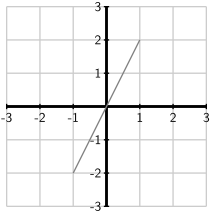
The determinant of this matrix is \(0\) because the parallelogram formed by the vector has no area. This suggests that the determinant of a matrix whose columns are linearly dependent is \(0\text{.}\)
We find that \(\det(A) = -4\text{,}\)\(\det(B) = 2\text{,}\) and \(\det(AB) = -8\text{.}\) This suggests that \(\det(AB) = \det(A) \det(B)\text{.}\)
In the next section, we will learn an algebraic technique for computing determinants. In the meantime, we will simply note that we can define determinants for \(n\times
n\) matrices by measuring the volume of a box defined by the columns of the matrix, even if this box resides in \(\real^n\) for some very large \(n\text{.}\)
Though the previous activity deals with determinants of \(2\times2\) matrices, it illustrates some important properties of determinants that are true more generally.
If \(A\) is a triangular matrix, then \(\det(A)\) equals the product of the entries on the diagonal. For example,
Rather than simply thinking of the determinant as the area of a parallelogram, we may also think of it as a factor by which areas are scaled under the matrix transformation defined by the matrix. Applying the matrix transformation defined by \(B\) will scale area by \(\det(B)\text{.}\) If we then compose \(B\) with the matrix transformation defined by \(A\text{,}\) area will scale a second time by the factor \(\det(A)\text{.}\) The net effect is that the matrix transformation defined by \(AB\) scales area by \(\det(A)\det(B)\) so that \(\det(AB)=\det(A)\det(B)\text{.}\)
Proposition9.3.8.
The determinant satisfies these properties:
The determinant of a triangular matrix equals the product of its diagonal entries. In particular, \(\det(I_n) = 1\text{.}\)
If \(P\) is obtained by interchanging two rows of the identity matrix, then \(\det(P) = -1\text{.}\)
\(\det(AB) = \det(A)\det(B)\text{.}\)
Subsection9.3.2Determinants and invertibility
Perhaps the most important property of determinants also appeared in the previous activity. We saw that when the columns of the matrix \(A\) are linearly dependent, the parallelogram formed by those vectors folds down onto a line. For instance, if \(A=\begin{bmatrix} 1 \amp 2 \\ -1 \amp -2 \\
\end{bmatrix}\text{,}\) then the resulting parallelogram, as shown in Figure 9.3.9, has zero area, which means that \(\det(A)=0\text{.}\)
Figure9.3.9.When the columns of \(A\) are linearly dependent, we find that \(\det(A) = 0\text{.}\)
The condition that the columns of \(A\) are linearly dependent is precisely the same as the condition that \(A\) is not invertible. This leads us to believe that \(A\) is not invertible if and only if its determinant is zero. The following proposition expresses this thought.
Proposition9.3.10.
The matrix \(A\) is invertible if and only if \(\det(A)
\neq 0\text{.}\)
 2.
2. 3.
3. 4.
4. 5.
5.