Activity 6.3.1.
In this activity, we will look at the span of sets of vectors in \(\real^3\text{.}\)
-
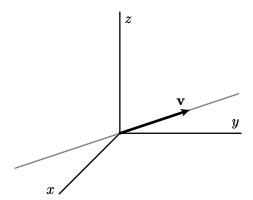
Suppose \(\vvec=\threevec{1}{2}{1}\text{.}\) Give a geometric description of \(\laspan{\vvec}\) and a rough sketch of \(\vvec\) and its span in Figure 6.3.1.
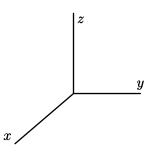
Figure 6.3.1. A three-dimensional coordinate system for sketching \(\vvec\) and its span. -
Now consider the two vectors\begin{equation*} \evec_1 = \threevec{1}{0}{0},~~~ \evec_2 = \threevec{0}{1}{0}\text{.} \end{equation*}Sketch the vectors below. Then give a geometric description of \(\laspan{\evec_1,\evec_2}\) and a rough sketch of the span in Figure 6.3.2.
Figure 6.3.2. A coordinate system for sketching \(\evec_1\text{,}\) \(\evec_2\text{,}\) and \(\laspan{\evec_1,\evec_2}\text{.}\) - Let’s now look at this situation algebraically by writing write \(\bvec = \threevec{b_1}{b_2}{b_3}\text{.}\) Determine the conditions on \(b_1\text{,}\) \(b_2\text{,}\) and \(b_3\) so that \(\bvec\) is in \(\laspan{\evec_1,\evec_2}\) by considering the linear system\begin{equation*} \left[\begin{array}{rr} \evec_1 \amp \evec_2 \\ \end{array}\right] ~\xvec = \bvec \end{equation*}or\begin{equation*} \left[\begin{array}{rr} 1 \amp 0 \\ 0 \amp 1 \\ 0 \amp 0 \\ \end{array}\right] \xvec = \threevec{b_1}{b_2}{b_3}\text{.} \end{equation*}Explain how this relates to your sketch of \(\laspan{\evec_1,\evec_2}\text{.}\)
- Consider the vectors\begin{equation*} \vvec_1 = \threevec{1}{1}{-1},~~ \vvec_2 = \threevec{0}{2}{1}. \end{equation*}
- Is the vector \(\bvec=\threevec{1}{-2}{4}\) in \(\laspan{\vvec_1,\vvec_2}\text{?}\)
- Is the vector \(\bvec=\threevec{-2}{0}{3}\) in \(\laspan{\vvec_1,\vvec_2}\text{?}\)
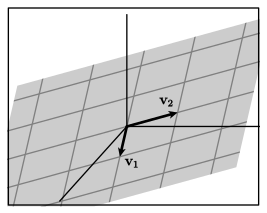
- Give a geometric description of \(\laspan{\vvec_1,\vvec_2}\text{.}\)
- Consider the vectors\begin{equation*} \vvec_1 = \threevec{1}{1}{-1}, \vvec_2 = \threevec{0}{2}{1}, \vvec_3 = \threevec{1}{-2}{4}\text{.} \end{equation*}Form the matrix \(\left[\begin{array}{rrrr} \vvec_1 \amp \vvec_2 \amp \vvec_3 \end{array}\right]\) and find its reduced row echelon form. What does this tell you about \(\laspan{\vvec_1,\vvec_2,\vvec_3}\text{?}\)
- If the span of a set of vectors \(\vvec_1,\vvec_2,\ldots,\vvec_n\) is \(\real^3\text{,}\) what can you say about the pivot positions of the matrix \(\left[\begin{array}{rrrr} \vvec_1\amp\vvec_2\amp\ldots\amp\vvec_n \end{array}\right]\text{?}\)
- What is the smallest number of vectors such that \(\laspan{\vvec_1,\vvec_2,\ldots,\vvec_n} = \real^3\text{?}\)
Solution.
- \(\laspan{\vvec}\) is the line defined by \(\vvec\text{.}\)
- \(\laspan{\evec_1,\evec_2}\) is the \(xy\)-plane.
- For the linear system to be consistent, we need \(b_3=0\text{,}\) which means that the third coordinate of the vector \(\bvec\) must be 0 for \(\bvec\) to be in \(\laspan{\evec_1,\evec_2}\text{.}\) In other words, \(\bvec\) must lie in the \(xy\)-plane.
- We consider the two cases.
- We have the augmented matrix\begin{equation*} \left[\begin{array}{rr|r} 1 \amp 0 \amp 1 \\ 1 \amp 2 \amp -2 \\ -1 \amp 1 \amp 4 \end{array}\right] \sim \left[\begin{array}{rr|r} 1 \amp 0 \amp 0 \\ 0 \amp 1 \amp 0 \\ 0 \amp 0 \amp 1 \end{array}\right]\text{,} \end{equation*}which shows that the system is inconsistent. Therefore, \(\bvec\) is not in \(\laspan{\vvec_1, \vvec_2}\text{.}\)
- We have the augmented matrix\begin{equation*} \left[\begin{array}{rr|r} 1 \amp 0 \amp -2 \\ 1 \amp 2 \amp 0 \\ -1 \amp 1 \amp 3 \end{array}\right] \sim \left[\begin{array}{rr|r} 1 \amp 0 \amp -2 \\ 0 \amp 1 \amp 1 \\ 0 \amp 0 \amp 0 \end{array}\right]\text{,} \end{equation*}which shows that the system is consistent. Therefore, \(\bvec\) is in \(\laspan{\vvec_1, \vvec_2}\text{.}\)
- The span is the plane in \(\real^3\) defined by \(\vvec_1\) and \(\vvec_2\text{.}\)
- We have the reduced row echelon form\begin{equation*} \left[\begin{array}{rrr} 1 \amp 0 \amp 1 \\ 1 \amp 2 \amp -2 \\ -1 \amp 1 \amp 4 \end{array}\right] \sim \left[\begin{array}{rrr} 1 \amp 0 \amp 0 \\ 0 \amp 1 \amp 0 \\ 0 \amp 0 \amp 1 \end{array}\right]\text{.} \end{equation*}Since there is a pivot position in every row, this says that every equation \(A\xvec=\bvec\) is consistent. The \(\laspan{\vvec_1, \vvec_2, \vvec_3}\) is therefore \(\real^3\text{.}\)
- There must be a pivot position in every row.
- If a set of vectors spans \(\real^3\text{,}\) its corresponding matrix must have a pivot position in every row. Because there can be at most one pivot position in a column, there must be at least three columns. Therefore, the smallest number of vectors that span \(\real^3\) is three.