Section 10.1 Subpaces
Our goal is to develop a common framework for describing subsets like the span of the columns of a matrix and the solution space to a homogeneous equation. That leads us to the following definition.
Definition 10.1.1.
A subspace of \(\real^n\) is a subset of \(\real^n\) that is the span of a set of vectors. Therefore a subspace is closed under vector addition and scalar multiplication.
Since we have explored the concept of span in some detail, this definition just gives us a new word to describe something familiar. Let’s look at some examples.
Example 10.1.2. Subspaces of \(\real^3\).
In
Activity 6.3.1 and the following discussion, we looked at subspaces in
\(\real^3\) without explicitly using that language. Let’s recall some of those examples.
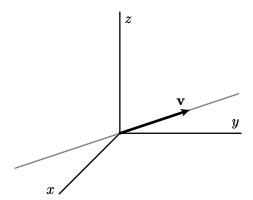
Suppose we have a single nonzero vector \(\vvec\text{.}\) The span of \(\vvec\) is a subspace, which we’ll write as \(S =
\laspan{\vvec}\text{.}\) As we have seen, the span of a single vector consists of all scalar multiples of that vector, and these form a line passing through the origin.
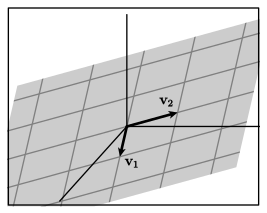
If instead we have two linearly independent vectors \(\vvec_1\) and \(\vvec_2\text{,}\) the subspace \(S=\laspan{\vvec_1,\vvec_2}\) is a plane passing through the origin.
Consider the three vectors \(\evec_1\text{,}\) \(\evec_2\text{,}\) and \(\evec_3\text{.}\) Since we know that every 3-dimensional vector can be written as a linear combination, we have \(S = \laspan{\evec_1, \evec_2,
\evec_3} = \real^3\text{.}\)
One more subspace worth mentioning is \(S=\laspan{\zerovec}\text{.}\) Since any linear combination of the zero vector is itself the zero vector, this subspace consists of a single vector, \(\zerovec\text{.}\)
In fact, any subspace of \(\real^3\) is one of these types: the origin, a line, a plane, or all of \(\real^3\text{.}\)
Definition 10.1.3.
A basis for a subspace \(S\) of \(\real^n\) is a set of vectors in \(S\) that are linearly independent and whose span is \(S\text{.}\) We say that the dimension of the subspace \(S\text{,}\) denoted \(\dim
S\text{,}\) is the number of vectors in any basis.
Subspaces of \(\real^3\) are either
0-dimensional, consisting of the single vector \(\zerovec\text{,}\)
a 1-dimensional line,
a 2-dimensional plane, or
the 3-dimensional subspace \(\real^3\text{.}\)
There is no 4-dimensional subspace of \(\real^3\) because there is no linearly independent set of four vectors in \(\real^3\text{.}\)
There are two important subspaces associated to any matrix. The first subspace associated to a matrix that we’ll consider is its column space.
Definition 10.1.4.
If \(A\) is an \(m\times n\) matrix, we call the span of its columns the column space of \(A\) and denote it as \(\col(A)\text{.}\)
Notice that the columns of \(A\) are vectors in \(\real^m\text{,}\) which means that any linear combination of the columns is also in \(\real^m\text{.}\) Since the column space is described as the span of a set of vectors, we see that \(\col(A)\) is a subspace of \(\real^m\text{.}\)
Activity 10.1.1.
We will explore some column spaces in this activity.
Consider the matrix
\begin{equation*}
A= \left[\begin{array}{rrr}
\vvec_1 \amp \vvec_2 \amp \vvec_3
\end{array}\right]
=
\left[\begin{array}{rrr}
1 \amp 3 \amp -1 \\
-2 \amp 0 \amp -4 \\
1 \amp 2 \amp 0 \\
\end{array}\right].
\end{equation*}
Since \(\col(A)\) is the span of the columns, we have
\begin{equation*}
\col(A) = \laspan{\vvec_1,\vvec_2,\vvec_3}.
\end{equation*}
Explain why \(\vvec_3\) can be written as a linear combination of \(\vvec_1\) and \(\vvec_2\) and why \(\col(A)=\laspan{\vvec_1,\vvec_2}\text{.}\)
Explain why the vectors \(\vvec_1\) and \(\vvec_2\) form a basis for \(\col(A)\) and why \(\col(A)\) is a 2-dimensional subspace of \(\real^3\) and therefore a plane.
Now consider the matrix \(B\) and its reduced row echelon form:
\begin{equation*}
B = \left[\begin{array}{rrrr}
-2 \amp -4 \amp 0 \amp 6 \\
1 \amp 2 \amp 0 \amp -3 \\
\end{array}\right]
\sim
\left[\begin{array}{rrrr}
1 \amp 2 \amp 0 \amp -3 \\
0 \amp 0 \amp 0 \amp 0 \\
\end{array}\right].
\end{equation*}
Explain why \(\col(B)\) is a 1-dimensional subspace of \(\real^2\) and is therefore a line.
For a general matrix \(A\text{,}\) what is the relationship between the dimension \(\dim~\col(A)\) and the number of pivot positions in \(A\text{?}\)
How does the location of the pivot positions indicate a basis for \(\col(A)\text{?}\)
If \(A\) is an invertible \(9\times9\) matrix, what can you say about the column space \(\col(A)\text{?}\)
Suppose that \(A\) is an \(8\times 10\) matrix and that \(\col(A) = \real^8\text{.}\) If \(\bvec\) is an 8-dimensional vector, what can you say about the equation \(A\xvec = \bvec\text{?}\)
Solution.
We have
\begin{equation*}
A=\left[\begin{array}{rrr}
1 \amp 3 \amp -1 \\
-2 \amp 0 \amp -4 \\
1 \amp 2 \amp 0 \\
\end{array}\right]\sim
\left[\begin{array}{rrr}
1 \amp 0 \amp 2 \\
0 \amp 1 \amp -1 \\
0 \amp 0 \amp 0 \\
\end{array}\right]\text{,}
\end{equation*}
which shows that the vectors are not linearly independent and, in fact, that \(\vvec_3 = 2\vvec_1 -
\vvec_2\text{.}\) As we’ve seen several times, this means that any linear combination of \(\vvec_1\text{,}\) \(\vvec_2\text{,}\) and \(\vvec_3\) can be written as a linear combination of \(\vvec_1\) and \(\vvec_2\) alone and hence that
\begin{equation*}
\col(A)=\laspan{\vvec_1,\vvec_2,\vvec_3} =
\laspan{\vvec_1,\vvec_2}.
\end{equation*}
The reduced row echelon form of \(A\) shows that \(\vvec_1\) and \(\vvec_2\) are linearly independent. We also know that the span of these two vectors is \(\col(A)\text{.}\) Therefore, they form a basis for \(\col(A)\text{.}\)
Denoting the columns of \(B\) as \(\vvec_i\text{,}\) the reduced row echelon form shows that \(\vvec_2=2\vvec_1\text{,}\) \(\vvec_3=0\vvec_1\text{,}\) and \(\vvec_4 = -3\vvec_1\text{.}\) Therefore, any linear combination of \(\vvec_1\text{,}\) \(\vvec_2\text{,}\) \(\vvec_3\text{,}\) and \(\vvec_4\) can be written as a linear combination of \(\vvec_1\) alone. This means that \(\vvec_1\) forms a basis for \(\col(A)\text{,}\) which is then the line consisting of all scalar multiples of \(\vvec_1\text{.}\) p
The number of vectors in a basis of \(\col(A)\) equals the number of pivot positions. Therefore, \(\dim~\col(A)\) equals the number of pivot positions in \(A\text{.}\)
As the examples in this activity illustrate, the columns of \(A\) that contain pivot positions form a basis for \(\col(A)\text{.}\)
If \(A\) is invertible, then it has a pivot position in every row, which means that the span of the columns is \(\real^9\text{.}\) Therefore, \(\col(A) =
\real^9\text{.}\)
Since \(\col(A)=\real^8\text{,}\) we know that every 8-dimensional vector \(\bvec\) is in \(\col(A)\text{.}\) This means that \(\bvec\) is in the span of the columns of \(A\) so the equation \(A\xvec = \bvec\) must be consistent.
Example 10.1.5.
Consider the matrix \(A\) and its reduced row echelon form:
\begin{equation*}
A =
\left[\begin{array}{rrrrr}
2 \amp 0 \amp -4 \amp -6 \amp 0 \\
-4 \amp -1 \amp 7 \amp 11 \amp 2 \\
0 \amp -1 \amp -1 \amp -1 \amp 2 \\
\end{array}\right]
\sim
\left[\begin{array}{rrrrr}
1 \amp 0 \amp -2 \amp -3 \amp 0 \\
0 \amp 1 \amp 1 \amp 1 \amp -2 \\
0 \amp 0 \amp 0 \amp 0 \amp 0 \\
\end{array}\right],
\end{equation*}
and denote the columns of \(A\) as \(\vvec_1,\vvec_2,\ldots,\vvec_5\text{.}\)
It is certainly true that \(\col(A) =
\laspan{\vvec_1,\vvec_2,\ldots,\vvec_5}\) by the definition of the column space. However, the reduced row echelon form of the matrix shows us that the vectors are not linearly independent so \(\vvec_1,\vvec_2,\ldots,\vvec_5\) do not form a basis for \(\col(A)\text{.}\)
From the reduced row echelon form, however, we can see that
\begin{equation*}
\begin{aligned}
\vvec_3 \amp {}={} -2\vvec_1 + \vvec_2 \\
\vvec_4 \amp {}={} -3\vvec_1 + \vvec_2 \\
\vvec_5 \amp {}={} -2\vvec_2 \\
\end{aligned}\text{.}
\end{equation*}
This means that any linear combination of \(\vvec_1,\vvec_2,\ldots,\vvec_5\) can be written as a linear combination of just \(\vvec_1\) and \(\vvec_2\text{.}\) Therefore, we see that \(\col(A) = \laspan{\vvec_1,\vvec_2}\text{.}\)
Moreover, the reduced row echelon form shows that \(\vvec_1\) and \(\vvec_2\) are linearly independent, which implies that they form a basis for \(\col(A)\text{.}\) This means that \(\col(A)\) is a 2-dimensional subspace of \(\real^3\text{,}\) which is a plane in \(\real^3\text{,}\) having basis
\begin{equation*}
\threevec{2}{-4}{0},
\qquad
\threevec{0}{-1}{1}\text{.}
\end{equation*}
In general, a column without a pivot position can be written as a linear combination of the columns that have pivot positions. This means that a basis for \(\col(A)\) will always be given by the columns of \(A\) having pivot positions. This leads us to the following definition and proposition.
Definition 10.1.6.
The rank of a matrix \(A\) is the number of pivot positions in \(A\) and is denoted by \(\rank(A)\text{.}\)
The second subspace associated to a matrix is its null space.
Definition 10.1.7.
If \(A\) is an \(m\times n\) matrix, we call the subset of vectors \(\xvec\) in \(\real^n\) satisfying \(A\xvec = \zerovec\) the null space of \(A\) and denote it by \(\nul(A)\text{.}\)
Remember that a subspace is a subset that can be represented as the span of a set of vectors. The column space of \(A\text{,}\) which is simply the span of the columns of \(A\text{,}\) fits this definition. It may not be immediately clear how the null space of \(A\text{,}\) which is the solution space of the equation \(A\xvec
= \zerovec\text{,}\) does, but we will see that \(\nul(A)\) is a subspace of \(\real^n\text{.}\)
Activity 10.1.2.
We will explore some null spaces in this activity and see why \(\nul(A)\) satisfies the definition of a subspace.
Consider the matrix
\begin{equation*}
A=\begin{bmatrix}
1 \amp 3 \amp -1 \amp 2 \\
-2 \amp 0 \amp -4 \amp 2 \\
1 \amp 2 \amp 0 \amp 1
\end{bmatrix}
\end{equation*}
and give a parametric description of the solution space to the equation
\(A\xvec = \zerovec\text{.}\) In other words, give a parametric description of
\(\nul(A)\text{.}\)
This parametric description shows that the vectors satisfying the equation \(A\xvec=\zerovec\) can be written as a linear combination of a set of vectors. In other words, this description shows why \(\nul(A)\) is the span of a set of vectors and is therefore a subspace. Identify a set of vectors whose span is \(\nul(A)\text{.}\)
Use this set of vectors to find a basis for \(\nul(A)\) and state the dimension of \(\nul(A)\text{.}\)
The null space \(\nul(A)\) is a subspace of \(\real^p\) for which value of \(p\text{?}\)
Now consider the matrix \(B\) whose reduced row echelon form is given by
\begin{equation*}
B \sim
\left[\begin{array}{rrrr}
1 \amp 2 \amp 0 \amp -3 \\
0 \amp 0 \amp 0 \amp 0 \\
\end{array}\right].
\end{equation*}
Give a parametric description of \(\nul(B)\text{.}\)
The parametric description gives a set of vectors that span \(\nul(B)\text{.}\) Explain why this set of vectors is linearly independent and hence forms a basis. What is the dimension of \(\nul(B)\text{?}\)
For a general matrix \(A\text{,}\) how does the number of pivot positions indicate the dimension of \(\nul(A)\text{?}\)
Suppose that the columns of a matrix \(A\) are linearly independent. What can you say about \(\nul(A)\text{?}\)
Solution.
We have
\begin{equation*}
A=\begin{bmatrix}
1 \amp 3 \amp -1 \amp 2 \\
-2 \amp 0 \amp -4 \amp 2 \\
1 \amp 2 \amp 0 \amp 1 \\
\end{bmatrix}\sim
\begin{bmatrix}
1 \amp 0 \amp 2 \amp -1 \\
0 \amp 1 \amp -1 \amp 1 \\
0 \amp 0 \amp 0 \amp 0\\
\end{bmatrix},
\end{equation*}
which leads to the parametric description of the solution space to the homogeneous equation:
\begin{equation*}
\xvec=x_3\fourvec{-2}{1}{1}0 +
x_4\fourvec{1}{-1}01.
\end{equation*}
The parametric description shows that every solution to the equation \(A\xvec=\zerovec\) is a linear combination of \(\wvec_1=\fourvec{-2}110\) and \(\wvec_2=\fourvec1{-1}01\text{.}\)
The vectors \(\wvec_1\) and \(\wvec_2\) are linearly independent so they form a basis for \(\nul(A)\text{.}\) Therefore, \(\nul(A)\) is 2-dimensional.
The vectors in \(\nul(A)\) are 4-dimensional so \(\nul(A)\) is a subspace of \(\real^4\text{.}\)
A parametric description of the null space is \(\xvec=x_2\fourvec{-2}{1}{0}{0} + x_3\fourvec0010 +
x_4\fourvec{3}{0}{-2}{1}\text{.}\) We can check that the vectors
\begin{equation*}
\fourvec{-2}100,~~~\fourvec0010,~~~\fourvec30{-2}1
\end{equation*}
are linearly independent so they form a basis for \(\nul(A)\text{.}\) This means that \(\nul(A)\) is 3-dimensional.
The number of vectors in a basis of the null space equals the number of free variables that appear in the equation \(A\xvec=\zerovec\text{,}\) which is the number of columns that do not have pivot positions. This says that \(\dim~\nul(A)\) equals the number of columns of \(A\) minus the number of pivot positions.
If the columns are linearly independent, then the homogeneous equation \(A\xvec=\zerovec\) has only the zero solution \(\xvec=\zerovec\text{.}\) Therefore, \(\nul(A) = \{\zerovec\}\text{.}\)
Subsection 10.1.1 Summary
The column space \(\col(A)\) contains all the vectors \(\bvec\) for which the equation \(A\xvec = \bvec\) is consistent. The null space \(\nul(A)\) is the solution space to the equation \(A\xvec = \zerovec\text{.}\)
A subspace \(S\) of \(\real^p\) is a subset of \(\real^p\) that can be represented as the span of a set of vectors. A basis of \(S\) is a linearly independent set of vectors whose span is \(S\text{.}\)
If \(A\) is an \(m\times n\) matrix, the column space \(\col(A)\) is the span of the columns of \(A\) and forms a subspace of \(\real^m\text{.}\)
A basis for \(\col(A)\) is found from the columns of \(A\) that have pivot positions. The dimension is therefore \(\dim~\col(A) = \rank(A)\text{.}\)
The null space \(\nul(A)\) is the solution space to the homogeneous equation \(A\xvec = \zerovec\) and is a subspace of \(\real^n\text{.}\)
A basis for \(\nul(A)\) is found through a parametric description of the solution space of \(A\xvec =
\zerovec\text{.}\) Since each free variable provides a basis vector, and the number of free variables plus the number of pivots equals the number of columns, we have that \(\dim~\nul(A) = n -
\rank(A)\text{.}\)