Activity 3.2.1.
In this activity, we seek to describe various matrix transformations by finding the matrix \(A\) that gives the desired transformation. All of the transformations that we study here have the form \(T:\real^2\to\real^2\text{.}\) Recall from the video that the matrix \(A\) is completely determined by where it takes he vectors \(\twovec{1}{0}\) and\(\twovec{0}{1}\) Let’s look at some examples and apply these observations.
-
To begin, suppose that \(T\) is the matrix transformation that takes a two-dimensional vector \(\xvec\) as an input and outputs \(T(\xvec)\text{,}\) the two-dimensional vector obtained by rotating \(\xvec\) counterclockwise by \(90^\circ\text{,}\) as shown in Figure 3.2.1.
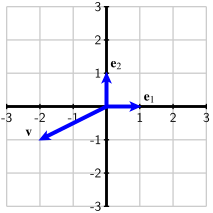
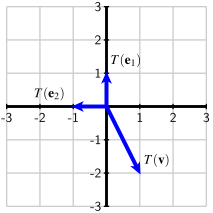
Figure 3.2.1. The matrix transformation \(T\) takes two-dimensional vectors on the left and rotates them by \(90^\circ\) counterclockwise into the vectors on the right. - Give the matrix \(A\text{,}\) such that \(T(\xvec)=A\xvec\text{.}\)
- If \(\vvec=\twovec{-2}{-1}\) as shown on the left in Figure 3.2.1, use your matrix to determine \(T(\vvec)\) and verify that it agrees with that shown on the right of Figure 3.2.1.
- If \(\xvec=\twovec xy\text{,}\) determine the vector \(T(\xvec)\) obtained by rotating \(\xvec\) counterclockwise by \(90^\circ\text{.}\)
- Find the matrix of the transformation that has no effect on vectors; that is, \(T(\xvec) = \xvec\text{.}\)
- Find the matrix of the transformation that reflects vectors in \(\real^2\) across the line \(y=x\text{.}\)
- What is the result of composing the reflection you found in the previous part with itself; that is, what is the effect of reflecting across the line \(y=x\) and then reflecting across this line again? Provide a geometric explanation for your result as well as an algebraic one.
- A vertical shear takes the vector \(\twovec 10\) to the vector \(\twovec 1m\) and leaves the vector \(\twovec 01\) fixed. Give the matrix for this transformation where \(m=2. \)
- A horizontal shear takes the vector \(\twovec 01\) to the vector \(\twovec m1\) and leaves the vector \(\twovec 10\) fixed. Give the matrix for this transformation where \(m=1.\)
- You found the the matrix that rotates vectors counterclockwise in the plane by \(90^\circ\) in the first problem of this activity . Compare the result of rotating by \(90^\circ\) and then reflecting in the line \(y=x\) to the result of first reflecting in \(y=x\) and then rotating \(90^\circ\text{.}\)
- Find the matrix that results from composing a \(90^\circ\) rotation with itself four times; that is, if \(T\) is the matrix transformation that rotates vectors by \(90^\circ\text{,}\) find the matrix for \(T\circ T\circ T \circ T\text{.}\) Explain why your result makes sense geometrically.
- Explain why the matrix that rotates vectors counterclockwise by an angle \(\theta\) is\begin{equation*} \left[\begin{array}{rr} \cos\theta \amp -\sin\theta \\ \sin\theta \amp \cos\theta \\ \end{array}\right]\text{.} \end{equation*}
Solution.
We use the fact that the columns of the requested matrices have the form \(\left[\begin{array}{rr} T(\evec_1) \amp
T(\evec_2) \end{array}\right]\text{.}\)
- \(\left[\begin{array}{rr} 1 \amp 0 \\ 0 \amp 1 \\ \end{array}\right] \text{.}\)
- \(\left[\begin{array}{rr} 0 \amp 1 \\ 1 \amp 0 \\ \end{array}\right] \text{.}\)
- The composition of this reflection with itself is described by the matrix \(\left[\begin{array}{rr} 1 \amp 0 \\ 0 \amp 1 \\ \end{array}\right] \text{,}\) which we just saw is the matrix for the identity transformation. This means that reflecting a vector in the line \(y=x\) twice produces the original vector.
- \(\left[\begin{array}{rr} 0 \amp -1 \\ 1 \amp 0 \\ \end{array}\right] \text{.}\)
-
If we first rotate and then reflect, we obtain the matrix transformation defined by\begin{equation*} \left[\begin{array}{rr} 0 \amp 1 \\ 1 \amp 0 \\ \end{array}\right] \left[\begin{array}{rr} 0 \amp -1 \\ 1 \amp 0 \\ \end{array}\right] = \left[\begin{array}{rr} 1 \amp 0 \\ 0 \amp -1 \\ \end{array}\right]\text{,} \end{equation*}which is the matrix for reflecting in the horizontal axis.If we first reflect and then rotate, we obtain the matrix\begin{equation*} \left[\begin{array}{rr} 0 \amp -1 \\ 1 \amp 0 \\ \end{array}\right] \left[\begin{array}{rr} 0 \amp 1 \\ 1 \amp 0 \\ \end{array}\right] = \left[\begin{array}{rr} -1 \amp 0 \\ 0 \amp 1 \\ \end{array}\right]\text{,} \end{equation*}which is the matrix for reflecting in the vertical axis.
- Composing four times corresponds gives us the identity matrix \(I\text{.}\)
- If we consider the effect of rotating the vector \(\twovec{1}{0}\) by an angle \(\theta\text{,}\) we obtain the vector \(\twovec{\cos\theta}{\sin\theta}\text{.}\)

