Section4.2The geometry of linear systems of equations in two and three unknowns
We will develop an algorithm, which is usually called Gaussian elimination, to describe the solution space of a linear system. This algorithm plays a central role in much of what is to come. But first we consider some examples.
Exploration4.2.1.
In this activity, we will consider some simple examples of systems of linear equations.
Give a description of the solution space to the linear system:
\begin{equation*}
\begin{alignedat}{3}
x \amp = \amp 2 \\
y \amp = \amp -1. \\
\end{alignedat}
\end{equation*}
Give a description of the solution space to the linear system:
Now we can use the second equation to determine that \(y=-1\text{,}\) substitute that value into the first equation, and determine that \(x=-1\text{.}\) This tells us that the linear system has one solution \((x,y,z) =
(-1,-1,2)\text{.}\)
Notice that we can rewrite the first equation as \(x=-1-3y\) and substitute this into the second equation to obtain
This tells us that \(y=-1\) and \(x=-1-3y
= 2\text{.}\) The linear system therefore has one solution \((x,y) = (2,-1)\text{.}\)
No matter the value of \(x\text{,}\) we have \(0x = 0\text{.}\) Therefore, the solution space to the equation \(0x=0\) is all real numbers \(x\text{.}\) In other words, this equation does not place a restriction on the value of \(x\text{.}\)
By contrast, the equation \(0x=5\) has no solutions since no value of \(x\text{,}\) when multiplied by \(0\text{,}\) can produce \(5\text{.}\)
Activity4.2.2.The geometry of systems of equations in two unknowns.
In this activity, we consider sets of linear equations having just two unknowns. In this case, we can graph the solutions sets for the equations, which allows us to visualize different types of behavior.
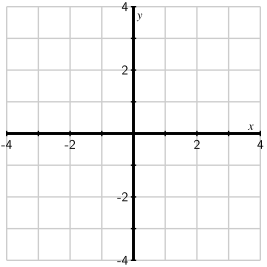
On the grid below, graph the lines
\begin{equation*}
\begin{aligned}
y \amp = x+1 \\
y \amp = 2x-1\text{.} \\
\end{aligned}
\end{equation*}
At what point or points \((x,y)\text{,}\) do the lines intersect? How many points \((x,y)\) satisfy both equations?
On the grid below, graph the lines
\begin{equation*}
\begin{aligned}
y \amp = x+1 \\
y \amp = x-1\text{.} \\
\end{aligned}
\end{equation*}
At what point or points \((x,y)\text{,}\) do the lines intersect? How many points \((x,y)\) satisfy both equations?
On the grid below, graph the line
\begin{equation*}
y = x+1\text{.}
\end{equation*}
How many points \((x,y)\) satisfy this equation?
On the grid below, graph the lines
\begin{equation*}
\begin{aligned}
y \amp = x+1 \\
y \amp = 2x-1 \\
y \amp = -x. \\
\end{aligned}
\end{equation*}
At what point or points \((x,y)\text{,}\) do the lines intersect? How many points \((x,y)\) satisfy all three equations?
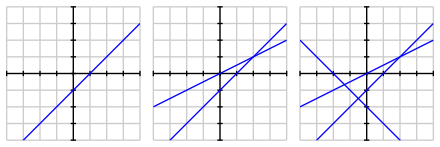
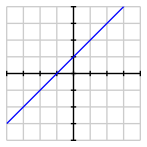
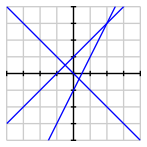
The examples in this introductory activity demonstrate several possible outcomes for the solutions to a set of linear equations. Notice that we are interested in points that satisfy each equation in the set and that these are seen as intersection points of the lines. Similar to the examples considered in the activity, three types of outcomes are seen in Figure 4.2.1.
Figure4.2.1.Three possible graphs for sets of linear equations in two unknowns.
In this figure, we see that
With a single equation, there are infinitely many points \((x,y)\) satisfying that equation.
Adding a second equation adds another condition we place on the points \((x,y)\) resulting in a single point that satisfies both equations.
Adding a third equation adds a third condition on the points \((x,y)\text{,}\) and there is no point that satisfies all three equations.
Generally speaking, a single equation will have many solutions, in fact, infinitely many. As we add equations, we add conditions which lead, in a sense we will make precise later, to a smaller number of solutions. Eventually, we have too many equations and find there are no points that satisfy all of them.
Answer.
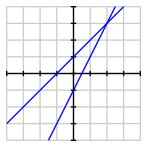
This is exactly one point, the point \((2,3)\text{,}\) that satisfies both equations.
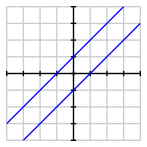
There are no points that satisfy both equations.
There are infinitely many points.
There are no points that satisfy all three equations.
Solution.
The graph of the two lines is as shown on the right. There is a single point, the point \((2,3)\text{,}\) at which the lines intersect. Therefore, there is a single point that satisfies both equations.
These two lines are parallel, which means there is no point at which the lines intersect. Therefore, there is no point that satisfies both equations.
There are infinitely many points that lie on this line and that, therefore, satisfy this single equation.
These three lines do not have a common intersection point. Consequently, there is no point satisfying all three equations.
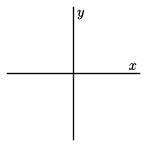
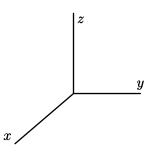
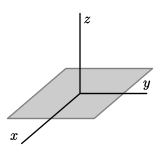
When we consider an equation in three unknowns graphically, we need to add a third coordinate axis, as shown in Figure 4.2.2.
Figure4.2.2.Coordinate systems in two and three dimensions.
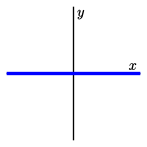
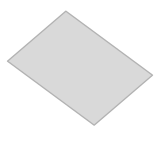
As shown in Figure 4.2.3, a linear equation in two unknowns, such as \(y=0\text{,}\) is a line while a linear equation in three unknowns, such as \(z=0\text{,}\) is a plane.
Figure4.2.3.The solutions to the equation \(y=0\) in two dimensions and \(z=0\) in three.
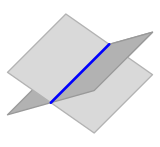
In three unknowns, the set of solutions to one linear equation forms a plane. The set of solutions to a pair of linear equations is seen graphically as the intersection of the two planes. As in Figure 4.2.4, we typically expect this intersection to be a line.
Figure4.2.4.A single plane and the intersection of two planes.
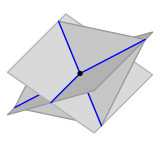
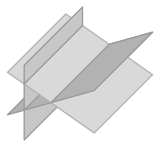
When we add a third equation, we are looking for the intersection of three planes, which we expect to form a point, as in the left of Figure 4.2.5. However, in certain special cases, it may happen that there are no solutions, as seen on the right.
Figure4.2.5.Two examples showing the intersections of three planes.
Activity4.2.3.
This activity considers sets of equations having three unknowns. In this case, we know that the solutions of a single equation form a plane. If it helps with visualization, consider using \(3\times5\)-inch index cards to represent planes.
Is it possible that there are no solutions to two linear equations in three unknowns? Either sketch an example or state a reason why it can’t happen.
Is it possible that there is exactly one solution to two linear equations in three unknowns? Either sketch an example or state a reason why it can’t happen.
Is it possible that the solutions to four equations in three unknowns form a line? Either sketch an example or state a reason why it can’t happen.
What would you usually expect for the set of solutions to four equations in three unknowns?
Suppose we have a set of 500 linear equations in 10 unknowns. Which of the three possibilities would you expect to hold?
Suppose we have a set of 10 linear equations in 500 unknowns. Which of the three possibilities would you expect to hold?
Answer.
Yes.
No.
Yes.
We would expect there to be no solutions.
We would expect there to be no solutions.
We would expect there to be infinitely many solutions.
Solution.
Yes, it is possible if the two planes are parallel to one another.
No, this is not possible. Two planes will either intersect in a line, if they are not parallel, or not intersect at all, if they are parallel.
Yes, it is possible that four planes intersect in a line. One may sketch four planes that intersect in, say, the \(z\)-axis.
In general, we would expect there to be no solutions to four equations in three unknowns because there are more equations than unknowns.
Since there are more equations than unknowns, we would expect there to be no solutions. We cannot guarantee this, however.
Since there are fewer equations than unknowns, we would expect there to be infinitely many solutions. We cannot guarantee this, however.