Skip to main content Contents Prev Up Next \(\newcommand{\avec}{{\mathbf a}}
\newcommand{\bvec}{{\mathbf b}}
\newcommand{\cvec}{{\mathbf c}}
\newcommand{\dvec}{{\mathbf d}}
\newcommand{\dtil}{\widetilde{\mathbf d}}
\newcommand{\evec}{{\mathbf e}}
\newcommand{\fvec}{{\mathbf f}}
\newcommand{\nvec}{{\mathbf n}}
\newcommand{\pvec}{{\mathbf p}}
\newcommand{\qvec}{{\mathbf q}}
\newcommand{\svec}{{\mathbf s}}
\newcommand{\tvec}{{\mathbf t}}
\newcommand{\uvec}{{\mathbf u}}
\newcommand{\vvec}{{\mathbf v}}
\newcommand{\wvec}{{\mathbf w}}
\newcommand{\xvec}{{\mathbf x}}
\newcommand{\yvec}{{\mathbf y}}
\newcommand{\zvec}{{\mathbf z}}
\newcommand{\rvec}{{\mathbf r}}
\newcommand{\mvec}{{\mathbf m}}
\newcommand{\zerovec}{{\mathbf 0}}
\newcommand{\onevec}{{\mathbf 1}}
\newcommand{\real}{{\mathbb R}}
\newcommand{\twovec}[2]{\left[\begin{array}{r}#1 \\ #2
\end{array}\right]}
\newcommand{\ctwovec}[2]{\left[\begin{array}{c}#1 \\ #2
\end{array}\right]}
\newcommand{\threevec}[3]{\left[\begin{array}{r}#1 \\ #2 \\ #3
\end{array}\right]}
\newcommand{\cthreevec}[3]{\left[\begin{array}{c}#1 \\ #2 \\ #3
\end{array}\right]}
\newcommand{\fourvec}[4]{\left[\begin{array}{r}#1 \\ #2 \\ #3 \\ #4
\end{array}\right]}
\newcommand{\cfourvec}[4]{\left[\begin{array}{c}#1 \\ #2 \\ #3 \\ #4
\end{array}\right]}
\newcommand{\fivevec}[5]{\left[\begin{array}{r}#1 \\ #2 \\ #3 \\
#4 \\ #5 \\ \end{array}\right]}
\newcommand{\cfivevec}[5]{\left[\begin{array}{c}#1 \\ #2 \\ #3 \\
#4 \\ #5 \\ \end{array}\right]}
\newcommand{\mattwo}[4]{\left[\begin{array}{rr}#1 \amp #2 \\ #3 \amp #4 \\ \end{array}\right]}
\newcommand{\laspan}[1]{\text{Span}\{#1\}}
\newcommand{\bcal}{{\cal B}}
\newcommand{\ccal}{{\cal C}}
\newcommand{\scal}{{\cal S}}
\newcommand{\wcal}{{\cal W}}
\newcommand{\ecal}{{\cal E}}
\newcommand{\coords}[2]{\left\{#1\right\}_{#2}}
\newcommand{\gray}[1]{\color{gray}{#1}}
\newcommand{\lgray}[1]{\color{lightgray}{#1}}
\newcommand{\rank}{\operatorname{rank}}
\newcommand{\row}{\text{Row}}
\newcommand{\col}{\text{Col}}
\renewcommand{\row}{\text{Row}}
\newcommand{\nul}{\text{Nul}}
\newcommand{\var}{\text{Var}}
\newcommand{\corr}{\text{corr}}
\newcommand{\len}[1]{\left|#1\right|}
\newcommand{\bbar}{\overline{\bvec}}
\newcommand{\bhat}{\widehat{\bvec}}
\newcommand{\bperp}{\bvec^\perp}
\newcommand{\xhat}{\widehat{\xvec}}
\newcommand{\vhat}{\widehat{\vvec}}
\newcommand{\uhat}{\widehat{\uvec}}
\newcommand{\what}{\widehat{\wvec}}
\newcommand{\Sighat}{\widehat{\Sigma}}
\newcommand{\lt}{<}
\newcommand{\gt}{>}
\newcommand{\amp}{&}
\definecolor{fillinmathshade}{gray}{0.9}
\newcommand{\fillinmath}[1]{\mathchoice{\colorbox{fillinmathshade}{$\displaystyle \phantom{\,#1\,}$}}{\colorbox{fillinmathshade}{$\textstyle \phantom{\,#1\,}$}}{\colorbox{fillinmathshade}{$\scriptstyle \phantom{\,#1\,}$}}{\colorbox{fillinmathshade}{$\scriptscriptstyle\phantom{\,#1\,}$}}}
\)
Section 1.1 Scalar Multiplication
Activity 1.1.1 . Scalar Multiplication and Vector Addition.
Suppose that
\begin{equation*}
\vvec = \left[\begin{array}{r} 3 \\ 1 \end{array}
\right],
\wvec = \left[\begin{array}{r} -1 \\ 2 \end{array}
\right].
\end{equation*}
Find expressions for the vectors
\begin{equation*}
\begin{array}{cccc}
\vvec, \amp 2\vvec, \amp -\vvec, \amp -2\vvec, \\
\wvec, \amp 2\wvec, \amp -\wvec, \amp -2\wvec\text{.} \\
\end{array}
\end{equation*}
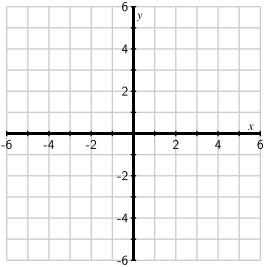
and sketch them using
Figure 1.1.1 .
Figure 1.1.1. Sketch the vectors on this grid.
What geometric effect does scalar multiplication have on a vector? Also, describe the effect that multiplying by a negative scalar has.
Sketch the vectors
\(\vvec, \wvec, \vvec + \wvec\) using
Figure 1.1.2 .
Figure 1.1.2. Sketch the vectors on this grid.
Consider vectors that have the form
\(\vvec +
c\wvec\) where
\(c\) is any scalar. Sketch a few of these vectors when, say,
\(c = -2, -1, 0, 1, \) and
\(2\text{.}\) Give a geometric description of this set of vectors.
Figure 1.1.3. Sketch the vectors on this grid.
If \(c\) and \(d\) are two scalars, then the vector
\begin{equation*}
c \vvec + d \wvec
\end{equation*}
is called a linear combination of the vectors \(\vvec\) and \(\wvec\text{.}\) Find the vector that is the linear combination when \(c = -2\) and \(d = 1\text{.}\)
Solution . Solutions to this preview activity are given in the text below.