Exploration 7.1.1.
Let’s begin by looking at some sets of vectors in \(\real^3\text{.}\) As we saw in the previous section, the span of a set of vectors in \(\real^3\) will be either a line, a plane, or \(\real^3\) itself.
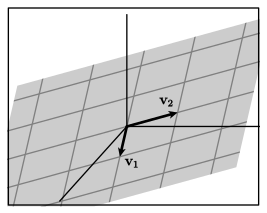
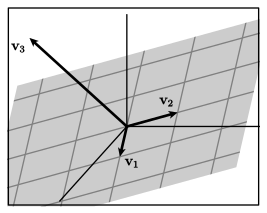
- Consider the following vectors in \(\real^3\text{:}\)\begin{equation*} \vvec_1=\threevec{0}{-1}{2}, \vvec_2=\threevec{3}{1}{-1}, \vvec_3=\threevec{2}{0}{1}\text{.} \end{equation*}Describe the span of these vectors, \(\laspan{\vvec_1,\vvec_2,\vvec_3}\text{,}\) as a line, a plane, or \(\real^3\text{.}\)
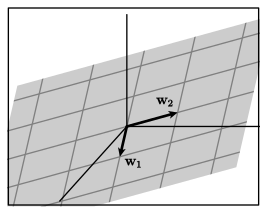
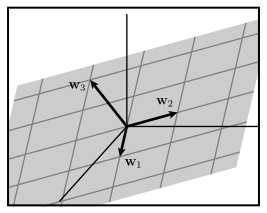
- Now consider the set of vectors:\begin{equation*} \wvec_1=\threevec{0}{-1}{2}, \wvec_2=\threevec{3}{1}{-1}, \wvec_3=\threevec{3}{0}{1}\text{.} \end{equation*}Describe the span of these vectors, \(\laspan{\wvec_1,\wvec_2,\wvec_3}\text{,}\) as a line, a plane, or \(\real^3\text{.}\)
- Show that the vector \(\wvec_3\) is a linear combination of \(\wvec_1\) and \(\wvec_2\) by finding weights such that\begin{equation*} \wvec_3 = c\wvec_1 + d\wvec_2\text{.} \end{equation*}
- Explain why any linear combination of \(\wvec_1\text{,}\) \(\wvec_2\text{,}\) and \(\wvec_3\text{,}\)\begin{equation*} c_1\wvec_1 + c_2\wvec_2 + c_3\wvec_3 \end{equation*}can be written as a linear combination of \(\wvec_1\) and \(\wvec_2\text{.}\)
- Explain why\begin{equation*} \laspan{\wvec_1,\wvec_2,\wvec_3} = \laspan{\wvec_1,\wvec_2}\text{.} \end{equation*}
Solution.
- We will construct the matrix whose columns are \(\vvec_1\text{,}\) \(\vvec_2\text{,}\) and \(\vvec_3\text{:}\)\begin{equation*} \begin{bmatrix} 0 \amp 3 \amp 2 \\ -1 \amp 1 \amp 0 \\ 2 \amp -1 \amp 1 \\ \end{bmatrix} \sim \begin{bmatrix} 1 \amp 0 \amp 0 \\ 0 \amp 1 \amp 0 \\ 0 \amp 0 \amp 1 \\ \end{bmatrix}. \end{equation*}Because there is a pivot in every row, Proposition 6.3.5 tells us that \(\laspan{\vvec_1,\vvec_2,\vvec_3} = \real^3\text{.}\)
- Similarly,\begin{equation*} \begin{bmatrix} 0 \amp 3 \amp 3 \\ -1 \amp 1 \amp 0 \\ 2 \amp -1 \amp 1 \\ \end{bmatrix} \sim \begin{bmatrix} 1 \amp 0 \amp 1 \\ 0 \amp 1 \amp 1 \\ 0 \amp 0 \amp 0 \\ \end{bmatrix}. \end{equation*}As there are two pivot positions, we see that \(\laspan{\wvec_1, \wvec_2, \wvec_3}\) is a plane in \(\real^3\text{.}\)
- We see that\begin{equation*} \left[ \begin{array}{rr|r} 0 \amp 3 \amp 3 \\ -1 \amp 1 \amp 0 \\ 2 \amp -1 \amp 1 \\ \end{array} \right] \sim \left[ \begin{array}{rr|r} 1 \amp 0 \amp 1 \\ 0 \amp 1 \amp 1 \\ 0 \amp 0 \amp 0 \\ \end{array} \right], \end{equation*}which tells us that \(\wvec_3 = \wvec_1 + \wvec_2\text{.}\)
- We have\begin{equation*} c_1\wvec_1 + c_2\wvec_2 + c_3\wvec_3 = c_1\wvec_1 + c_2\wvec_2 + c_3(\wvec_1+\wvec_2)= (c_1+c_3)\wvec_1 + (c_2+c_3)\wvec_2. \end{equation*}
- Any linear combination of \(\wvec_1\text{,}\) \(\wvec_2\text{,}\) and \(\wvec_3\) is itself a linear combination of \(\wvec_1\) and \(\wvec_2\text{.}\)