Activity 8.4.1.
This activity demonstrates how to determine the orthogonal projection of a vector onto a subspace of \(\real^m\text{.}\)
-
Let’s begin by considering a line \(L\text{,}\) defined by the vector \(\wvec=\twovec21\text{,}\) and a vector \(\bvec=\twovec24\) not on \(L\text{,}\) as illustrated in Figure 8.1.9.
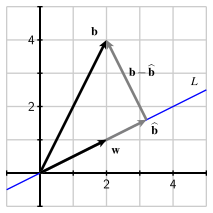
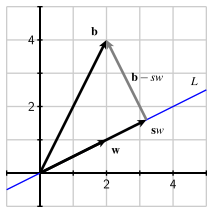
Figure 8.4.2. Finding the orthogonal projection of \(\bvec\) onto the line defined by \(\wvec\text{.}\) - To find \(\bhat\text{,}\) first notice that \(\bhat = s\wvec\) for some scalar \(s\text{.}\) Since \(\bvec-\bhat = \bvec - s\wvec\) is orthogonal to \(\wvec\text{,}\) what do we know about the dot product\begin{equation*} (\bvec-s\wvec)\cdot\wvec\text{?} \end{equation*}
- Apply the distributive property of dot products to find the scalar \(s\text{.}\) What is the vector \(\bhat\text{,}\) the orthogonal projection of \(\bvec\) onto \(L\text{?}\)
- More generally, explain why the orthogonal projection of \(\bvec\) onto the line defined by \(\wvec\) is\begin{equation*} \bhat= \frac{\bvec\cdot\wvec}{\wvec\cdot\wvec}~\wvec\text{.} \end{equation*}
-
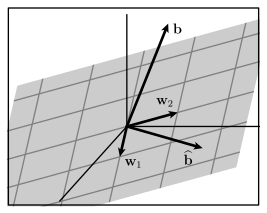
The same ideas apply more generally. Suppose we have an orthogonal set of vectors \(\wvec_1=\threevec22{-1}\) and \(\wvec_2=\threevec102\) that define a plane \(W\) in \(\real^3\text{.}\) If \(\bvec=\threevec396\) another vector in \(\real^3\text{,}\) we seek the vector \(\bhat\) on the plane \(W\) closest to \(\bvec\text{.}\) As before, the vector \(\bvec-\bhat\) will be orthogonal to \(W\text{,}\) as illustrated in Figure 8.4.3.
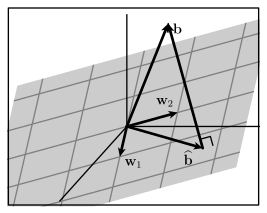
Figure 8.4.3. Given a plane \(W\) defined by the orthogonal vectors \(\wvec_1\) and \(\wvec_2\) and another vector \(\bvec\text{,}\) we seek the vector \(\bhat\) on \(W\) closest to \(\bvec\text{.}\) - The vector \(\bvec-\bhat\) is orthogonal to \(W\text{.}\) What does this say about the dot products: \((\bvec-\bhat)\cdot\wvec_1\) and \((\bvec-\bhat)\cdot\wvec_2\text{?}\)
- Let the columns of \(Q\) be an orthonormal basis for \(W\text{.}\) Explain why \(Q^T(\bvec-\bhat)= \zerovec\text{.}\)
- Since \(\bhat\) is in the plane, we can write it as a linear combination of the columns of \(Q\text{,}\) therefore, \(\bhat=Q^T\xhat\text{.}\) We need to find the weights for the linear combination which are given by the vector \(\xhat\text{.}\) Rewriting \(Q^T(\bvec-\bhat)=\zerovec\text{,}\) as \(Q^T(\bvec-Q^T\xhat)= \zerovec\text{.}\) Explain why \(\xhat=Q^T\bvec\text{.}\)
- Explain why \(\bhat = QQ^T\bvec\text{,}\) the orthogonal projection of \(\bvec\) onto the plane \(W\text{?}\)
Answer.
- 0
- \(\bhat = \twovec{16/5}{8/5}\text{.}\)
- \(\displaystyle \bhat= \frac{\bvec\cdot\wvec}{\wvec\cdot\wvec}\wvec\)
- 0
-
\(c_1= 2\)\(c_2=3\)
- \(\displaystyle \bhat = \threevec744\)
- We require that \(\bvec-\bhat\) be orthogonal to every vector \(\wvec_i\text{.}\)
- \(\displaystyle c_i=\frac{\bvec\cdot\uvec_i}{\uvec_i\cdot\uvec_i} = \bvec\cdot\uvec_i\)
- Use the fact that \(Q^T\bvec = \threevec{\bvec\cdot\uvec_1}{\vdots}{\bvec\cdot\uvec_n}\)
Solution.
- This dot product should be 0 since the vectors are orthogonal.
- \(\bhat=\frac{b\cdot\wvec}{\wvec\cdot\wvec}\wvec = \twovec{16/5}{8/5}\text{.}\)
- As before, \(\bhat= \frac{\bvec\cdot\wvec}{\wvec\cdot\wvec}\wvec\)
- These dot products are 0.
-
\(c_1=\frac{\bvec\cdot\wvec_1} {\wvec_1\cdot\wvec_1} = 2\)\(c_2=\frac{\bvec\cdot\wvec_2} {\wvec_2\cdot\wvec_2} = 3\)
- \(\displaystyle \bhat = \threevec744\)
- We know \(\bhat=c_1\wvec_1 + c_2\wvec_2 + \cdots + c_n\wvec_n\) and we can find \(c_i=\frac{\bvec\cdot\wvec_i}{\wvec_i\cdot\wvec_i}\) by requiring that \(\bvec-\bhat\) be orthogonal to every vector \(\wvec_i\text{.}\)
- The vectors \(\uvec_i\) form an orthogonal set and since \(\uvec_i\cdot\uvec_i = \len{\uvec_i}^2 = 1\text{,}\) the weights are \(c_i=\frac{\bvec\cdot\uvec_i}{\uvec_i\cdot\uvec_i} = \bvec\cdot\uvec_i\text{.}\)
- We have \(Q^T\bvec = \cthreevec{\bvec\cdot\uvec_1}{\vdots}{\bvec\cdot\uvec_n}\) so that\begin{equation*} QQ^T\bvec = (\bvec\cdot\uvec_1)~\uvec_1 + (\bvec\cdot\uvec_2)~\uvec_2 + \cdots + (\bvec\cdot\uvec_n)~\uvec_n=\bhat\text{.} \end{equation*}

